Bexar County has one of the largest criminal court systems in Texas. Whether your case is a Class B misdemeanor or a first-degree felony determines which court hears it, which prosecutors handle it, and how the case moves. Understanding the system helps you know what to expect — and why having a lawyer who regularly practices in these courts matters.
Where the criminal courts are
Most Bexar County criminal courts sit in downtown San Antonio around Main Plaza, next to San Fernando Cathedral:
- Cadena-Reeves Justice Center (300 Dolorosa) — the modern justice center that houses most of the felony criminal district courts and the misdemeanor county courts at law.
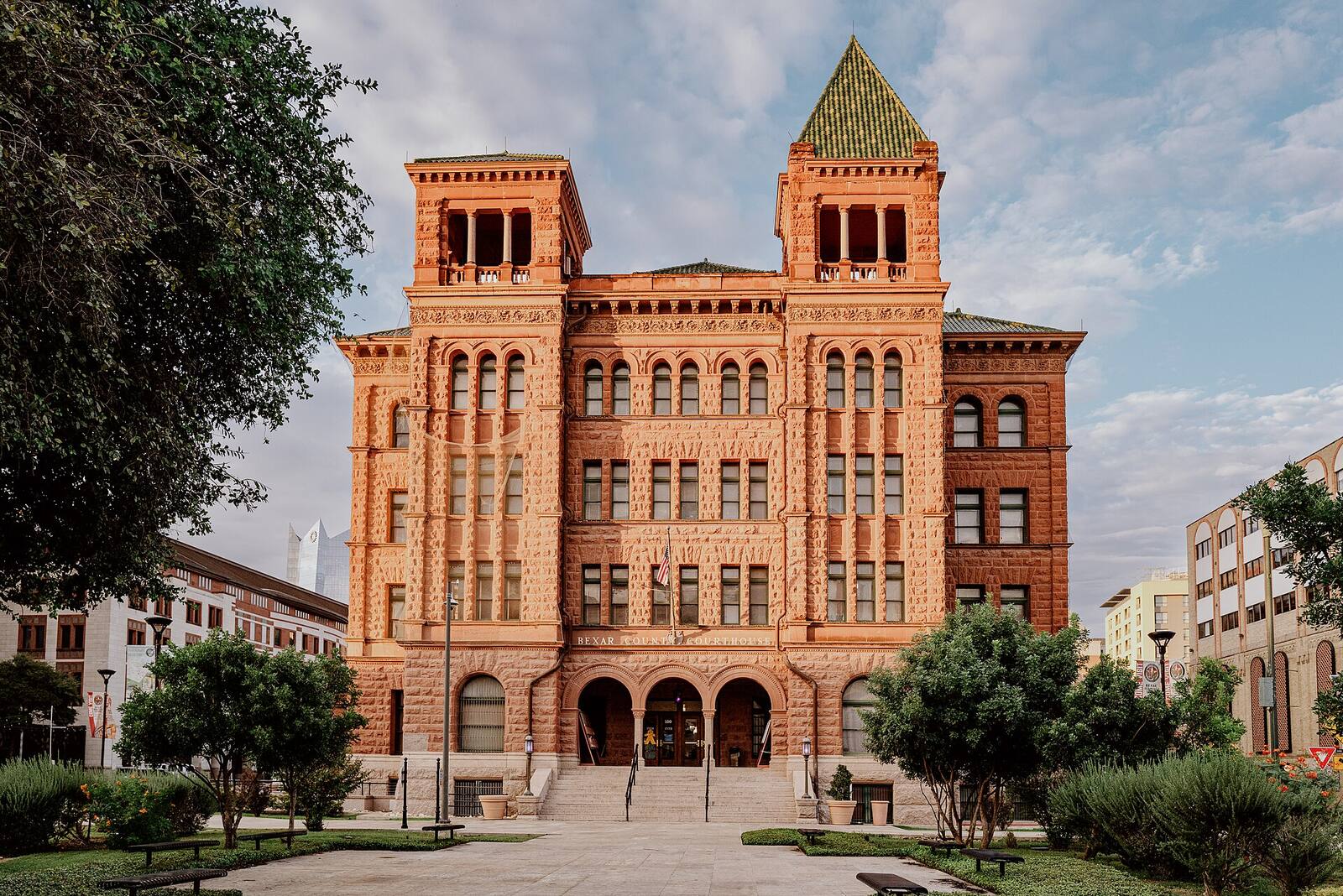
- Historic Bexar County Courthouse (100 Dolorosa) — the landmark red sandstone Romanesque Revival courthouse completed in 1896, connected to the Justice Center complex.
- Paul Elizondo Tower (101 W. Nueva) — houses county offices including the Criminal District Attorney's Office and District Clerk.
- Bexar County Adult Detention Center (North Comal Street) — the county jail, where magistration and the jail court operate.
Courtrooms and dockets move from time to time, so always check the courtroom listed on your bond paperwork or court notice, and confirm with your attorney before your court date. Parking downtown is limited — plan to arrive early and allow time for security screening.
The Bexar County criminal court system at a glance
| Court | What it handles | How many |
|---|---|---|
| Magistrates (Central Magistration) | Magistrate warnings, probable cause, setting bail, emergency protective orders, and arrest/search warrants | Operates around the clock at the jail |
| Municipal Courts (San Antonio and suburban cities) & Justice of the Peace Courts | Class C misdemeanors (fine-only): traffic tickets, public intoxication, minor in possession, disorderly conduct, Class C assault, theft under $100 | San Antonio Municipal Court plus suburban city courts and Bexar County's four JP precincts |
| County Courts at Law (criminal) | Class A and Class B misdemeanors: DWI, assault/family violence, theft, possession of marijuana, criminal trespass, unlawful carrying of a weapon, driving while license invalid | 13 criminal courts (of 15 County Courts at Law total), plus an auxiliary jail court and Family Violence Impact courts |
| Criminal District Courts | All felonies (state jail through capital) and misdemeanors involving official misconduct | 10 courts: 144th, 175th, 186th, 187th, 226th, 227th, 290th, 379th, 399th, 437th |
| Juvenile District Courts | Delinquent conduct by children ages 10–16 | Dedicated juvenile district courts |
| Fourth Court of Appeals (San Antonio) | Appeals from Bexar County and 31 other South and Southwest Texas counties | One intermediate appellate court |
| Texas Court of Criminal Appeals (Austin) | Texas's highest court for criminal cases; discretionary review, death penalty appeals, writs of habeas corpus | One statewide court |
The County Courts at Law — misdemeanor cases
Bexar County has 15 statutory County Courts at Law. Two handle civil cases. The remaining 13 are criminal courts that hear Class A and Class B misdemeanor cases from throughout the county. In addition, Bexar County uses an auxiliary jail court — located inside the Adult Detention Center — to handle misdemeanor cases for people who are still in custody, including evidentiary bond hearings for people who cannot afford their bond. The county also operates Family Violence Impact courts focused on family violence misdemeanors.
What happens in a County Court at Law
- Your case is randomly assigned to a court when the DA files an "information."
- Misdemeanor cases are prosecuted by assistant district attorneys in the DA's misdemeanor trial division.
- Each court has its own judge, court coordinator, and courtroom practices — some judges have different approaches to bond conditions, resets, and plea negotiations.
- Juries in misdemeanor trials have six jurors.
- Most misdemeanor DWI, assault, theft, and drug possession cases are handled here.
- Punishment ranges: Class B — up to 180 days in jail and a $2,000 fine; Class A — up to one year in jail and a $4,000 fine.
The Criminal District Courts — felony cases
Bexar County has ten district courts that give preference to criminal cases and hear the county's felony docket:
144th District Court
Felony criminal court
175th District Court
Felony criminal court
186th District Court
Felony criminal court
187th District Court
Felony criminal court
226th District Court
Felony criminal court
227th District Court
Felony criminal court
290th District Court
Felony criminal court
379th District Court
Felony criminal court
399th District Court
Felony criminal court
437th District Court
Felony criminal court
District judges are elected countywide to four-year terms. Felony cases are assigned to a district court after an indictment (or after the defendant waives indictment). Felony juries have twelve jurors, and a guilty verdict must be unanimous.
Felony cases in Bexar County also involve the district courts' own probation department — the Bexar County Community Supervision and Corrections Department (CSCD) — which supervises both felony and misdemeanor probationers. When a probationer is accused of a violation, the case returns to the same court that placed them on probation. See Motions to Revoke Probation.
Magistrates and the jail court
Bexar County's Central Magistrate operation works around the clock to process people arrested anywhere in the county. Magistrates give the Article 15.17 warnings, find probable cause, set bail, decide on personal bonds with input from Bexar County Pretrial Services, and issue emergency protective orders in family violence cases. Many hearings are conducted by video from the jail.
For misdemeanor defendants who remain in jail, the auxiliary jail court holds prompt evidentiary bond hearings to decide whether a PR bond or a bond reduction is appropriate based on the person's ability to pay. Read more in our bail and jail release guide.
Municipal and Justice of the Peace courts — Class C offenses
Fine-only Class C misdemeanors are not handled in the County Courts at Law. If the offense happened inside San Antonio city limits and was cited by SAPD, the case usually goes to the San Antonio Municipal Court. Offenses in suburban cities go to that city's municipal court, and offenses in unincorporated Bexar County go to one of the county's Justice of the Peace courts.
Even "just a ticket" can matter: a Class C conviction creates a criminal record, family violence-related Class C assaults carry special consequences, and some Class C offenses (like a third alcohol offense for a minor) can affect a driver's license. Many Class C cases can be resolved through deferred disposition, which may allow a later expunction.
Juvenile courts
In Texas, children ages 10 through 16 who are accused of crimes are handled in the juvenile justice system, not adult criminal court. (Seventeen-year-olds are treated as adults in Texas criminal cases.) Bexar County has dedicated juvenile district courts and a juvenile probation department. See our Juvenile Defense page.
Specialty and treatment courts
Bexar County has built a range of specialty courts — sometimes called problem-solving or treatment courts — designed to address the underlying causes of criminal behavior instead of only punishing it. Programs have included courts focused on:
- Drug addiction (felony and misdemeanor drug courts);
- DWI offenders;
- Veterans (Veterans Treatment Court);
- Mental health;
- Family violence;
- Survivors of human trafficking and commercial sexual exploitation.
Successful completion of a specialty court program can lead to a reduced charge, a dismissal, or early termination of probation. Eligibility depends on the offense, criminal history, and the program's criteria. We can evaluate whether you may qualify and advocate for your admission.
Federal court in San Antonio
Federal crimes are prosecuted by the U.S. Attorney's Office in the United States District Court for the Western District of Texas, San Antonio Division. Federal court has its own rules, sentencing guidelines, and pretrial procedures, which are very different from Bexar County's state courts. See Federal Crimes.
Appeals
Appeals from Bexar County criminal convictions go to the Fourth Court of Appeals, which sits in San Antonio and covers 32 counties in South and Southwest Texas. From there, a party can ask the Texas Court of Criminal Appeals in Austin — the state's highest criminal court — to review the case. Notice of appeal generally must be filed within 30 days after sentencing (or after a motion for new trial is denied), so deadlines come quickly.
Tips for your Bexar County court date
- Arrive early. Downtown traffic, parking, and security lines can take 30–45 minutes.
- Dress respectfully — as you would for a job interview. No hats, tank tops, or clothing with offensive slogans.
- Bring your paperwork — bond papers, court notices, proof of classes or community service, and your ID.
- Leave weapons and prohibited items at home, including pocket knives.
- Silence your phone and be prepared to wait — dockets can be long, and cases are called in an order set by the court.
- Don't discuss your case in the hallways or elevators. You never know who is listening.
- If you're running late or sick, call your lawyer immediately. Missing court can result in a warrant.
Why local experience matters. Every courthouse has its own culture. Knowing how a particular court handles resets, bond modifications, plea offers, and trial settings — and knowing the prosecutors in that court — helps us anticipate problems and get better results. Call 210-201-3111 to talk about your case.
Court counts and locations are current to the best of our knowledge but can change as the Texas Legislature creates new courts and the county reorganizes dockets. Always confirm your court date and courtroom.